Bosch Dishwasher in Home Assistant — Schedule by Electricity Price
Bosch dishwasher via Home Connect: a dashboard with programme selection and finish-time control, plus a button that finds the cheapest hour to run.
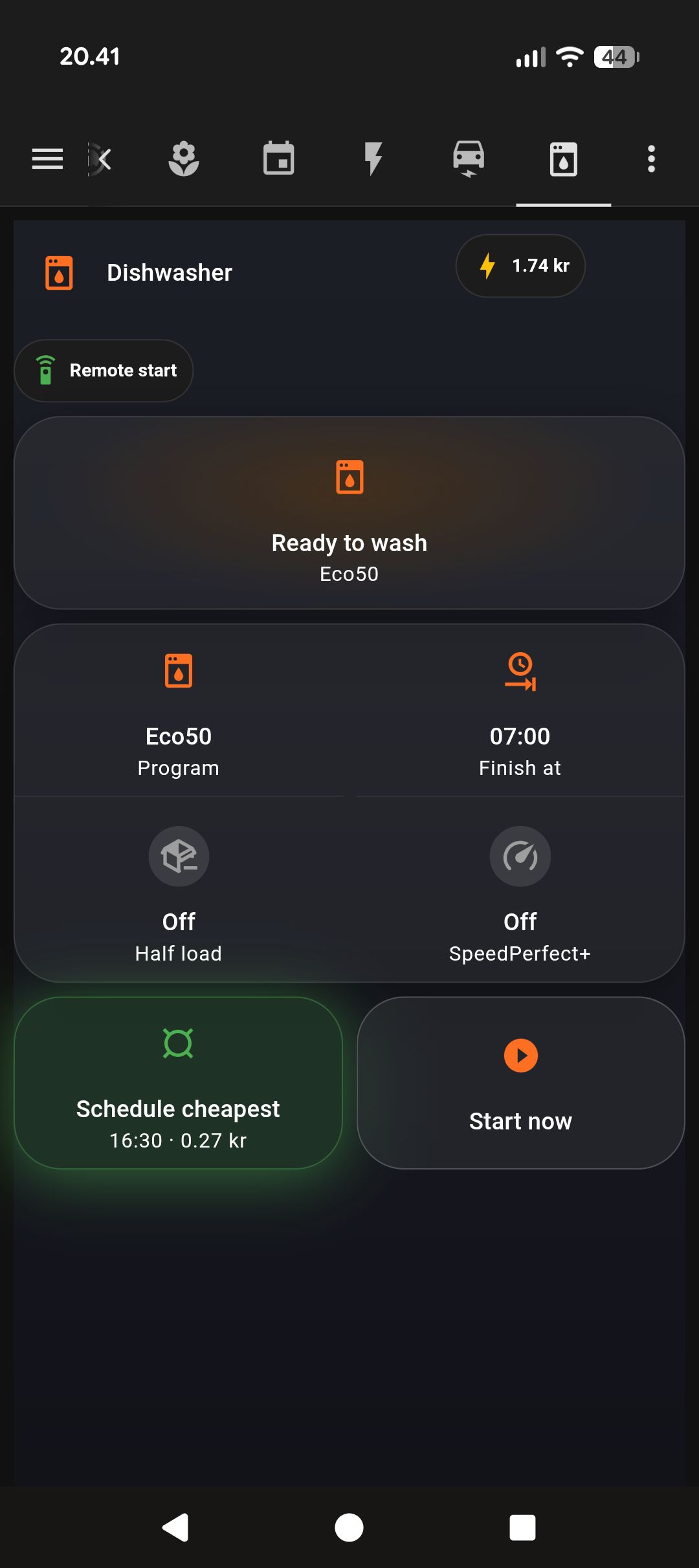
The dishwasher was the appliance I expected least from. It’s a Bosch. It connects to the Bosch Home Connect app, which is fine but just another app. I added the Home Connect integration (built into HA, no HACS needed — requires a Home Connect account) mostly out of completeness.
Then I realised it exposes enough control to do something actually useful: schedule the wash to start at the cheapest electricity hour.
What Home Connect exposes
After adding the integration, the dishwasher shows up with:
sensor.dishwasher_operation_state   — Ready, Run, Finished, etc.
sensor.dishwasher_program           — Eco50, Auto, Intensive, etc.
sensor.dishwasher_remaining_time
binary_sensor.dishwasher_remote_start_allowed
select.dishwasher_program
select.dishwasher_finish_at         — delayed start time
switch.dishwasher_half_load
switch.dishwasher_speed_perfect
button.dishwasher_start
The key one is select.dishwasher_finish_at. Bosch’s own delayed start lets you tell the machine what time you want it to finish — it works backwards from there. That’s the lever.
The dashboard card
The dashboard shows all controls in one glass card:
- Operation state (Ready to wash / Running / Finished)
- Programme selector
- Finish time selector
- Half load and SpeedPerfect toggles
- Two action buttons: Schedule cheapest and Start now
The “Schedule cheapest” button is a script that reads Energi Data Service (HACS) spot prices, finds the cheapest upcoming 1-hour window before midnight, adds the programme’s runtime, and sets select.dishwasher_finish_at to that time.
alias: Dishwasher — Schedule cheapest hour
sequence:
  - variables:
      prices: "{{ state_attr('sensor.energi_data_service', 'raw_today') | default([]) }}"
      now_h: "{{ now().hour }}"
      duration_h: 2
      best_hour: >
        {% set ns = namespace(hour=none, price=999) %}
        {% for h in prices %}
          {% if as_datetime(h.hour).hour >= now_h | int and h.price < ns.price %}
            {% set ns.price = h.price %}
            {% set ns.hour = h.hour %}
          {% endif %}
        {% endfor %}
        {{ ns.hour }}
  - service: select.select_option
    target:
      entity_id: select.dishwasher_finish_at
    data:
      option: >
        {{ (as_datetime(best_hour) + timedelta(hours=duration_h))
           .strftime('%H:%M') }}
  - service: button.press
    target:
      entity_id: button.dishwasher_start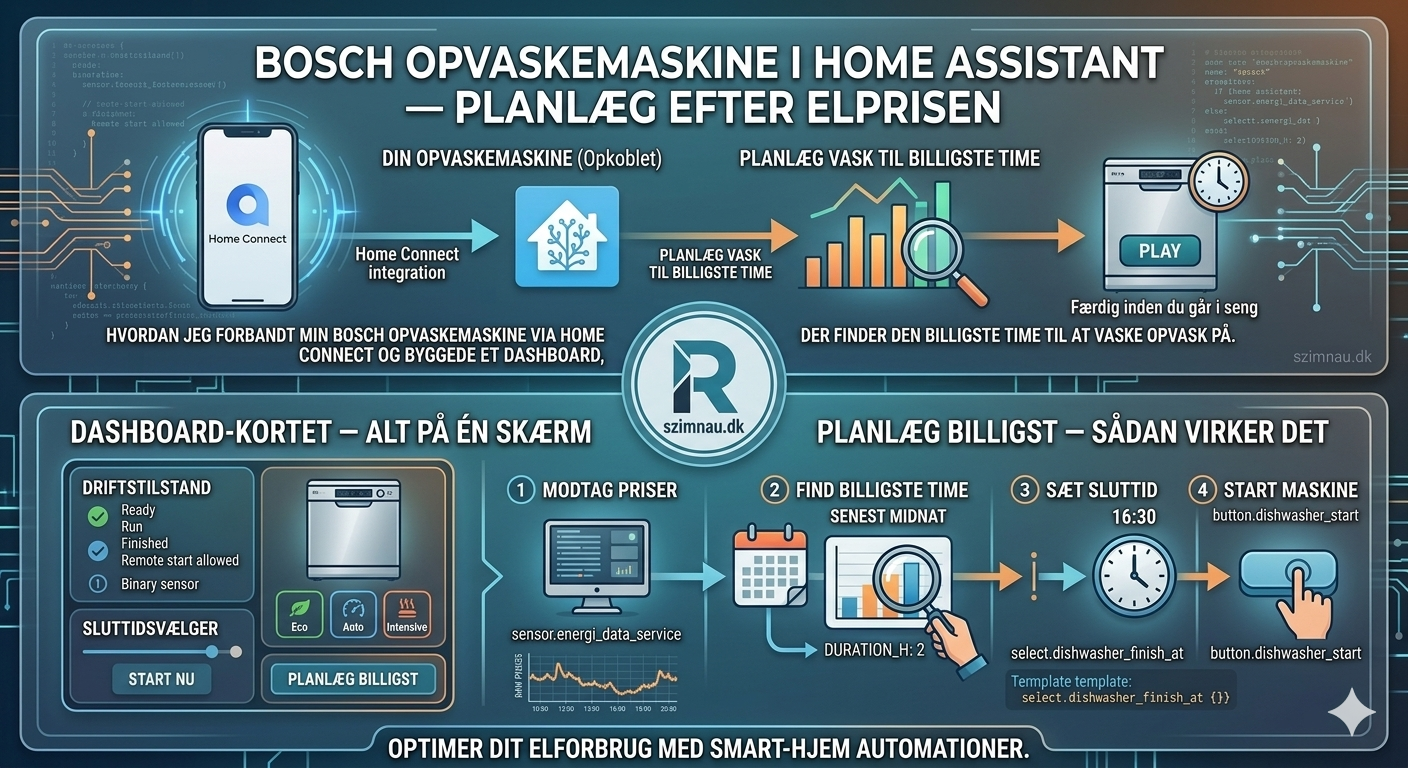
The card shows the result: “Schedule cheapest — 16:30 · 0.27 kr”. You see both the time and the price before you commit.
Why this is worth the effort
Eco50 runs about 2 hours. The price difference between the cheapest and most expensive hour of a typical Danish weekday is 1–3 DKK/kWh. At 0.8 kWh per cycle that’s 0.80–2.40 DKK saved per wash. Not dramatic individually. Over 300 washes a year it adds up, and more importantly the grid is less stressed during peaks.
The real benefit is behavioural. I load the dishwasher when it’s full, tap one button, and don’t think about it. The machine figures out when to run. It’s finished before I go to bed.
What doesn’t work
Remote start has to be enabled on the machine’s physical panel — there’s a small icon on the display. If I forget to enable it, the integration’s start command does nothing. I’ve forgotten this enough times that I added a chip to the card showing whether remote start is currently allowed.
Programme changes via HA only work before the machine starts. Once running, the state entities update but the selects become read-only. That’s a Bosch firmware limitation, not HA.
The Finished state notification is the other thing. The dishwasher sends a state update when done. I have an alert ticker entry for it on the home screen — “Dishwasher done — empty me!” — that appears until someone acknowledges it. Low-tech, but I actually empty it now instead of leaving it sitting there for three hours.